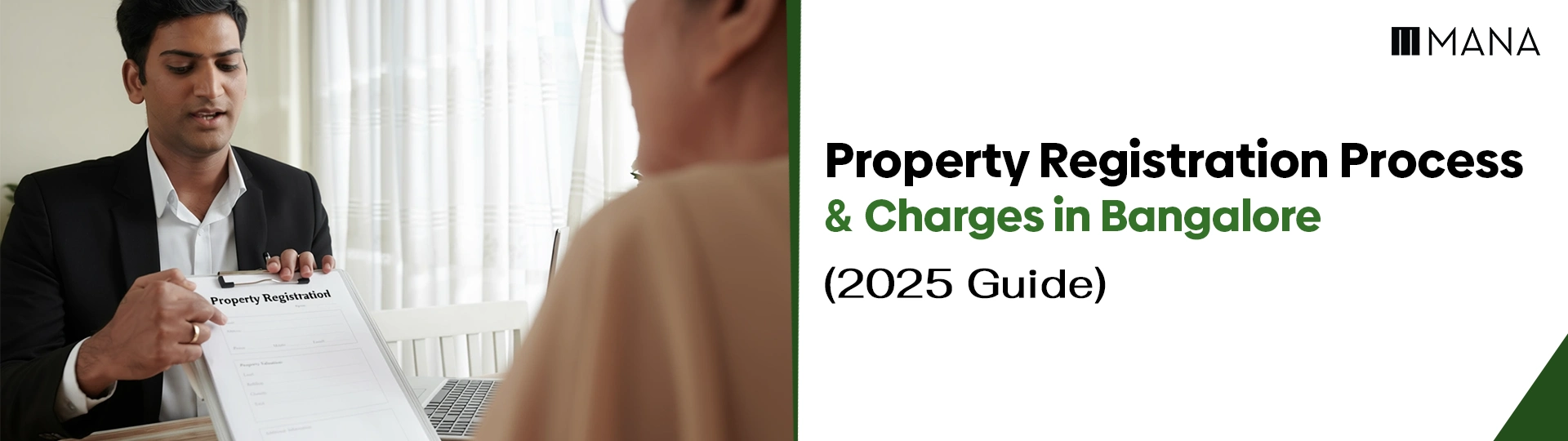
Property Registration Process and Charges in Bangalore (2025 Guide)
Planning on getting a new address in Bangalore? Great! But before those keys are handed over, there’s an essential legal step every buyer must take. Property Registration!
If words like “stamp duty” and “registration fee” make your head spin, you’re not alone. The property registration process in Bangalore is long and tedious, but it's something you can pull off, especially when you know the right steps. Whether it is a flat, plot, or independent home, understanding the current property registration charges in Bangalore could save you both money and stress.
Understanding Property Registration in Bangalore
What exactly is property registration? It’s the official recording of a property change in government records. It is a step that makes you the rightful owner and safeguards your investment.
It is not just paperwork. Registration underpins your legal claim as well; no shortcuts here. Every home buyer, developer, and investor is bound by the Karnataka Stamp Act and Registration laws.
Let’s now decode the journey, from paperwork prep to the final handover.
Property Registration Process in Bangalore: Step-by-Step Guide
Pre-Registration Requirements and Due Diligence
The journey starts with checking if all previous documents are in order. Buyers must confirm a clear property title, ensure that there are no pending legal disputes, and assess the property’s guidance (circle) value. Due diligence includes verifying the seller’s identity, Encumbrance Certificate (EC), occupancy certificate, latest tax receipts, and approved building plan.
Booking an appointment at the Sub-Registrar's Office (SRO)
Once documents are ready, schedule an appointment at the concerned Sub-Registrar’s Office (SRO) through the Kaveri 2.0 Online Portal. Booking ahead helps avoid long queues and speeds up processing.
Document Verification and Biometric Process
On the appointment day, both buyer and seller must personally visit the SRO. Officials will cross-check originals with copies and initiate the biometric process, including digital signatures and thumb impressions.
Final Registration and Receipt of Documents
After successful verification, both parties sign the sale deed and pay the property registration charges in Bangalore. The registrar records the transaction, and within a few days, the buyer receives the registered deed. Keep this document safe, as it’s your legal proof of ownership.
Documents Required for Property Registration in Bangalore
Thorough documentation is the backbone of a successful property registration. Missing even one paper may delay the entire process.
Essential Documents Checklist 2025
- Original Sale Deed (with two witnesses)
- Previous sale deeds, gift/partition deeds (if applicable)
- Encumbrance Certificate (EC) up to date
- Approved building plan/sanction plan
- Khata Certificate & extract
- Tax paid receipts (latest)
- Identity & address proofs (Aadhaar, PAN, passport, voter ID) for both parties
- Passport-size photographs of buyer & seller
- Power of Attorney (if any)
- No Objection Certificate (if required)
- DD/Challan for stamp duty and registration charges
Original Property Documents vs Certified Copies
Bring all original papers for verification at the SRO; however, certain older documents or government papers may be submitted as certified copies if originals are unavailable.
Documents Required for Different Property Types (Flat, Site, Land)
- Flats: All above, plus occupancy certificate and builder–buyer agreement.
- Plots/Sites: Mother deed, latest plot sketch, and relevant mutation records.
- Land: RTC extract, Mutation Records, and conversion order if land is converted from agricultural to non-agricultural.
Property Registration Charges in Bangalore 2025
Let’s strip away the jargon and break down the costs buyers face.
Registration Fee Structure (1% of Property Value)
The standard property registration charges in Bangalore are 1% of the property’s registered value.
Additional Charges and Processing Fees
Besides the flat 1%, expect minor processing fees, scanner fees, and user charges (usually between ₹1,000–₹5,000 per transaction).
How to Calculate Total Registration Costs
Total registration cost = Registration Fee (1% of value) + Stamp Duty + Surcharge + Cess + Minor user charges
For example, if you’re registering a flat worth ₹60 lakh, the registration fee is ₹60,000 (1%), with stamp duty and other charges extra.
Stamp Duty Rates and Charges in Bangalore
Stamp duty is a government tax paid on the sale agreement. Rates vary by property value.
Current Stamp Duty Slabs 2025
- Below ₹20 lakh: 2%
- ₹21–45 lakh: 3%
- Above ₹45 lakh: 5%
- Stamp duty is calculated on the higher of the sale amount or the government’s guidance value.
Stamp Duty Calculator and Examples
A buyer registering a ₹30 lakh property pays 3% stamp duty = ₹90,000. You can use the “Kaveri online valuation” tool for an instant estimate.
Surcharge and Cess on Stamp Duty
One can expect a surcharge (around 2%) and cess (10% of stamp duty) in urban areas, which gets added to the base rate for the total cost.
Stamp Duty & Deed Registration in Bangalore
Owning freehold property in Bangalore means having almost unlimited rights. You can lease it, sell it, or pass it through inheritance without any third-party interference. It’s like having a blank canvas where you decide what masterpiece to paint.
Legal Restrictions of Freehold Owners
Rates can differ for various deed types:
- Conveyance deed: Stamp (2-5%) + 1% registration
- Lease deed: Stamp (variable, often 1-5%)
- Sale agreement: 0.1% stamp (usually)
- Mortgage deed: 0.5% stamp
- Cancellation deed: Nominal stamp, registration charges apply
Plot Registry & Land Registration Charges
Plot registry or land registration attracts the same slab rates (up to 5% stamp duty and 1% registration).
Property Registration for Different Property Types
Flat Registration Process in Bangalore
For flats, the process includes verifying all builder NOCs, payment of maintenance/GST dues, and collecting the occupancy certificate. Once cleared, registration continues as above.
Site Registration Documents and Charges
Site purchases involve checking the mother deed, mutation, and plot sketches. Charges: 5% stamp duty and 1% registration are standard.
Land Registration Process in Karnataka
Follow similar due diligence, check conversion records for non-agricultural land, and pay necessary fees. The land registration charge is generally 5% stamp duty and 1% registration.
Property Registration for Different Property Types
Digital options have made the process smoother and more transparent.
Kaveri Online Registration Portal Guide
Start by logging into the “Kaveri 2.0 online registration” portal, where you can fill in property and party details, estimate taxes, and book appointment slots. This system is official, secure, and recommended by authorities.
E-Appointment for Registration of Deed
After entering your details, you can book an e-appointment at your chosen SRO. Arrive on time with all originals.
Digital Document Submission Process
Certain documents can be uploaded for pre-verification, reducing paperwork on registration day. Print and carry all receipts and form acknowledgements to the SRO.
Common Challenges in the Property Registration Process
Buying a dream home can feel draining if obstacles arise. Here’s how to handle the most frequent issues:
Lost Original Documents – What to Do?
File a police FIR and an application for certified copies at the SRO. Bring all acknowledgements and available paperwork for validation.
Registration Without Original Documents
Possible in exceptional scenarios (lost documents); must obtain certified copies and provide sufficient proof and affidavits.
Rectification Deed Process and Time Limits
Discovered an error in the deed post-registration? Apply for a rectification deed within the legal time window (usually within 4 months), signed by both parties, registered at SRO, with a nominal fee.
Post-Registration Procedures
The journey doesn’t end with registration. Here are the essential steps after purchase:
Updating Municipal Records (Khata Transfer)
Apply for a Khata transfer with the local BBMP or municipality to update records in the new owner’s name.
Property Tax Registration
Register your property for tax with the local body, using the registered sale deed and updated Khata.
Getting Registered Document Copies
Always collect multiple attested copies of the registered sale deed from the SRO. These are needed for loans, resale, or any legal process.
Legal Framework and Compliance
Legal Framework and Compliance
All land and property registrations are governed by the Registration Act, 1908, and the Karnataka Stamp Act, ensuring legal validity and enforceability of transactions.
IGR Karnataka – Official Portal Services
The official “IGR Karnataka” portal provides valuation, e-stamping, and appointment booking, all of which are essential for smooth processing.
Role of Sub-Registrar in Property Registration
The SRO verifies documents, collects charges/fees, and finally validates the sale for legal government records.
Legal Framework and Compliance
Registration isn’t just a legal formality. It can help at tax time, too!
Deductions under Section 80C:
Up to ₹1.5 lakh for stamp duty and property registration charges in Bangalore can be claimed for a new residential property.
Income Tax Benefits:
There are eligible deductions for registration and stamp expenses paid during the purchase.
GST Implications:
GST applies to under-construction properties, not to ready-to-move homes.
Registration Fee vs Stamp Duty:
Submit the sale deed, payment receipts, and bank statements during the next income tax filing window.
How to Claim Tax Benefits:
Stamp duty is a tax on transaction value. Registration fee is the cost of legalising the sale in the records.
Common Issues & Refunds
Refunds on wrongly paid stamp duty can be claimed within three months by applying to the District Registrar. Always double-check figures before payment to avoid this hassle.
The whole property registration process in Bangalore can seem complex. But with organised steps and professional partners like Mana Projects, you’re always in safe hands. By understanding the registration fee, stamp duty, required documentation, and digital options, you can move into your new home worry-free, knowing every legal thread is tied.
For more detailed guidance on the property registration charges in Bangalore and all legal steps, connect with the experts at Mana Projects. Make every property journey transparent, empowered, and secure.
FAQ’s
1. What is the validity of a registered sale deed?
A registered sale deed is valid for life, unless the property is transferred, sold, or legally contested.
2. Can property registration be done without the seller's presence?
Only with a verified Power of Attorney. Otherwise, both parties must attend.
3. How long does the registration process take in Bangalore?
If documents are in order, the process is usually completed within one to three days.
4. What is the difference between sale deed and registry?
The sale deed is a contract of sale; the registry is the official recording of this deed in government records.
5. How to verify property documents online?
Visit the “Kaveri 2.0” portal, enter property details, and cross-check ownership, past transactions, and EC.